
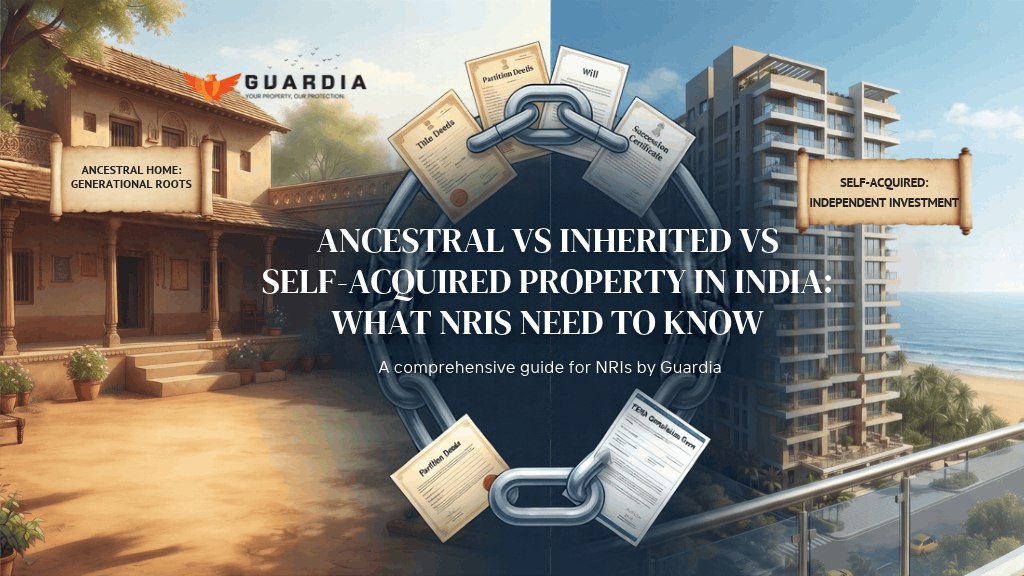
An ancestral house in India can become a complicated matter when some family members live abroad and others continue to occupy or manage the property. But before claiming a share, selling a property or initiating a partition, there is one important question to answer: Is the property ancestral, inherited or self-acquired?
These terms are often used interchangeably in family discussions, but they do not mean the same thing under Indian property and succession laws.
For example, a house purchased by a father using his own earnings does not automatically become ancestral property when his children inherit it. Similarly, property passed down through generations may not retain its ancestral character in every situation.
For Non-Resident Indians (NRIs), understanding this distinction is particularly important. It can affect who has a legal right to the property, whether a family member can claim a share, how partition works and whether the property can be sold or transferred.
This guide explains the difference between ancestral, inherited and self-acquired property in India, along with NRI inheritance rights, partition procedures, unauthorised property transfers and applicable FEMA rules.
1. What is considered ancestral property under Indian law?
Ancestral property is commonly understood as property that has remained within a family across generations. However, the legal meaning is more specific than the everyday use of the term.
Under Hindu Mitakshara law, ancestral property generally refers to property inherited from the paternal line in which descendants acquire a birthright as coparceners. Traditionally, the concept concerns property inherited from the father, grandfather or great-grandfather, subject to the property’s legal history and the rules governing succession and partition.
Not every property inherited from a parent or grandparent automatically becomes ancestral property.
For example, if a father independently purchased a house and his children inherit it after his death under Section 8 of the Hindu Succession Act, 1956, the property does not automatically become ancestral property in the hands of those children. The Supreme Court explained this distinction in Commissioner of Wealth Tax v. Chander Sen (1986) and Yudhishter v. Ashok Kumar (1986).
You can read the judgments here:
Ancestral property vs inherited property vs self-acquired property
| Type of property | What it means | How rights generally arise |
| Ancestral coparcenary property | Property that retains its ancestral coparcenary character under applicable Hindu law | Eligible coparceners acquire rights by birth |
| Individually inherited property | Property received through a parent’s or relative’s succession | Rights arise under the applicable succession law |
| Self-acquired property | Property purchased or acquired independently by an individual | The owner generally has the right to deal with it during their lifetime, subject to applicable law |
The distinction matters because it determines who can claim a share, whether a person can demand partition and whether a family member can transfer the property independently.
Before making a claim, examine the original title deed, previous ownership records, inheritance documents and any earlier partition deeds or court orders. Revenue records can help establish the property’s history, but a mutation entry alone does not conclusively establish title.
2. Can an NRI claim ancestral property in India while living abroad?
Yes. An NRI does not lose inheritance or coparcenary rights simply by living outside India.
An NRI who is an Indian citizen can generally claim the share available to them under the applicable personal law. Their overseas residence does not, by itself, make them ineligible to inherit property or participate in a partition.
For example, imagine three siblings whose family owns an ancestral house in India. One sibling lives in Hyderabad, another lives in Delhi, and the third has settled in Canada. The sibling living in Canada does not lose their legal rights merely because they are not physically present in India.
However, the actual share depends on several questions:
- Was the property genuinely ancestral coparcenary property?
- Which family members are legally entitled to a share?
- Did a valid partition take place earlier?
- Was the property transferred through a registered deed, will or family settlement?
- Which succession law applies?
- Is there an existing court order or pending dispute?
An NRI may pursue a property claim through an authorised representative, subject to the requirements of the court and the relevant proceedings. A properly executed Power of Attorney can help with documentation, representation and other authorised tasks.
The practical challenge is often not establishing that an NRI can claim a share. It is obtaining the documents, verifying the title and taking timely legal action when another family member refuses to cooperate.
If the dispute involves ownership, inheritance or an attempted transfer, Guardia’s legal services can be a relevant starting point for understanding the legal assistance required.
3. Do NRI daughters have equal rights in ancestral property?
Yes. A daughter does not lose her coparcenary rights merely because she is married or lives abroad.
Section 6 of the Hindu Succession Act, as amended in 2005, recognises a daughter of a Mitakshara coparcener as a coparcener in her own right, in the same manner as a son.
This means that, where the property qualifies as coparcenary property, a daughter generally has the same rights and liabilities as a son. Her marriage, residence outside India or financial independence does not by itself remove those rights.
The Supreme Court clarified the position in Vineeta Sharma v. Rakesh Sharma (2020). The Court held that a daughter born before or after the 2005 amendment can claim coparcenary status, and that the father’s status as alive on 9 September 2005 is not a condition for her right.
Read the Supreme Court judgment in Vineeta Sharma v. Rakesh Sharma.
What if the family says the daughter has already received her share?
This is where documents become important.
A family may argue that a daughter gave up her rights years ago or accepted money in exchange for her share. Whether that argument is legally valid depends on the nature, date and documentation of the transaction.
A valid partition or legally effective release may affect the claim. But a verbal statement that the daughter has already been compensated is not necessarily enough to establish that her rights were extinguished.
The relevant documents may include:
- Registered partition or release deed.
- Court decree recording a partition.
- Settlement documents.
- Relevant title and revenue records.
- Evidence of any legally recognised family arrangement.
The position must be examined against Section 6 and the principles explained in Vineeta Sharma. A family member should not assume that a daughter has no claim simply because she is married or lives overseas.
4. How is ancestral property divided after the owner’s death?
The division depends on whether the property is coparcenary property, separate property or property that has already been partitioned.
For Hindu families, the Hindu Succession Act, 1956 is particularly important. However, the Act does not apply to every Indian family. Succession may instead be governed by Muslim personal law, Christian succession law, the Indian Succession Act or another applicable legal framework.
If the property is Hindu coparcenary property
Section 6 of the Hindu Succession Act governs the devolution of a deceased coparcener’s interest in Mitakshara coparcenary property.
The deceased person’s interest is calculated by assuming a partition immediately before their death. That interest then devolves by testamentary or intestate succession, as applicable, rather than automatically passing only through survivorship.
The surviving coparceners’ rights and the shares of the deceased person’s legal heirs must therefore be considered separately.
If the property was the owner’s self-acquired property
If a Hindu male owner passes away without leaving a valid will, Section 8 of the Hindu Succession Act generally governs succession. Section 10 sets out how the property is distributed among Class I heirs.
Class I heirs can include:
- The widow.
- Sons and daughters.
- The mother.
- Certain descendants of predeceased children.
The exact distribution depends on which heirs survive the owner and the statutory rules.
What if the owner left a will?
A valid will can change how property is distributed, subject to the applicable succession law and any restrictions on the owner’s power to dispose of the property.
For ancestral coparcenary property, a person generally cannot make a will disposing of the entire joint family property as if they were its sole owner. The person’s legally disposable interest is a separate question.
Important: Do not calculate an NRI’s share simply by counting the owner’s children. The calculation may require identifying the coparceners, the deceased person’s notional share, other surviving heirs, earlier partitions and any valid testamentary documents.
For the statutory text, refer to the Hindu Succession Act, 1956 on India Code.
5. Can an NRI demand partition of ancestral property in India?
Yes. If an NRI has a legally recognised share in property, they can seek partition even if the other family members do not want to divide it.
Partition separates a person’s share from the jointly held property. It may take place through a mutual family arrangement or through court proceedings.
Partition by mutual agreement
If all entitled family members agree, they may enter into a legally valid partition arrangement. Depending on the nature of the transaction and the documents used, registration and stamp duty requirements may apply.
A proper partition document should identify:
- The property being divided.
- The parties and their respective shares.
- The portion allotted to each person.
- Access, easements and common areas, where relevant.
- Any payments made to equalise the shares.
- The manner in which possession will be handed over.
An NRI can generally participate through a properly authorised representative, subject to applicable documentation and registration requirements.
Partition through a court
If family members refuse to cooperate, an eligible co-owner or coparcener may consider filing a partition suit before the competent court.
A typical partition proceeding may involve:
- Establishing the property’s title and legal character.
- Identifying all persons entitled to a share.
- Determining each person’s share.
- Obtaining a preliminary decree declaring those shares.
- Working out the actual division through further proceedings.
- Obtaining a final decree and taking steps for possession and consequential records.
A preliminary decree does not necessarily mean that the physical property has already been divided. Further proceedings may be needed to identify and allot specific portions.
If the property cannot reasonably be divided, the court may have to consider other legally available methods, depending on the facts and applicable law.
For an NRI, the first step should be to establish the property’s title history and identify all necessary parties before deciding whether a negotiated partition or court action is appropriate.
6. Can a family member sell ancestral property without an NRI’s consent?
This is one of the most common concerns for NRIs who own property jointly with relatives.
A family member generally cannot sell another person’s share merely because they are managing or occupying the property. However, the legal position depends on the type of ownership and the authority under which the sale is made.
Consider a situation where three siblings have legally recognised interests in a property. One sibling signs a sale deed claiming to transfer the entire property without obtaining the other siblings’ signatures or authority.
The first question is whether that sibling had the legal right to transfer the entire property.
When one co-owner sells their share
Section 44 of the Transfer of Property Act, 1882 deals with transfers by co-owners. In general, a co-owner who is legally competent to transfer their interest may transfer their own share. The buyer acquires rights relating to that share, subject to the applicable conditions and liabilities.
That does not automatically give the seller authority to transfer the other co-owners’ interests.
There is also a specific restriction in Section 44 concerning a transfer of a share in an undivided family dwelling house to a person who is not a family member. Such a buyer does not automatically acquire a right to joint possession or common enjoyment of the house.
Read Section 44 of the Transfer of Property Act, 1882.
What if the property is managed by a Karta?
A Karta of a Hindu joint family may have powers to manage and, in certain circumstances, transfer joint family property. However, those powers are not unlimited.
A transfer may be legally supportable where it is made for recognised purposes such as:
- Legal necessity.
- Benefit of the estate.
- Indispensable duties of the family.
Whether a particular sale is valid depends on the facts, the authority of the Karta and the circumstances surrounding the transaction.
What if a relative uses a Power of Attorney?
A Power of Attorney does not automatically make the holder the owner of the property. It authorises the holder to perform the acts specified in the document.
If an NRI gives a relative authority to manage a property, the exact wording matters. Authority to collect rent, pay taxes or supervise repairs should not be treated as unrestricted authority to sell the property.
If you discover that a family member has attempted to sell or transfer property without proper authority, preserve the sale documents, title records and correspondence. A lawyer can examine whether the transaction is challengeable and which remedy is appropriate.
Depending on the facts, possible steps may include seeking an injunction, declaration, cancellation of an instrument or other relief. The correct remedy and limitation period must be assessed against the actual transaction and the person’s knowledge of it.
For disputes involving unauthorised transfers, ownership claims or family property transactions, see Guardia’s legal services.
7. What if siblings occupy the property and refuse to give the NRI their share?
A common situation is that one sibling continues to live in the family house while another lives abroad. Over time, the sibling in India may start treating the property as exclusively theirs.
But occupying a jointly owned property does not automatically make a person its sole owner.
Where family members hold recognised joint rights, one person’s possession is not necessarily adverse to the others. A claim of ouster or adverse possession requires specific legal elements and evidence; it cannot ordinarily be established simply by saying that one sibling has lived in the house for many years.
An NRI should examine the following:
- Who is named in the title documents?
- Was there an earlier partition or release?
- Has anyone expressly denied the NRI’s ownership?
- Has the property been rented out?
- Who has been receiving the rent?
- Have any sale, gift or mortgage documents been executed?
- Are there messages or letters acknowledging the NRI’s share?
Can the NRI claim rental income?
If the property is jointly owned and is being rented out, the NRI may have a claim to their proportionate entitlement to rental income, depending on the ownership structure and applicable law.
The amount will depend on the person’s legally established share, the rental arrangement and any relevant expenses or agreements.
An NRI should not rely solely on verbal assurances from the family. Written requests for rent statements, copies of tenancy agreements and property accounts can help establish a record.
If the property is being managed from India, Guardia’s property management services may help with practical oversight such as coordination, maintenance and tenant-related matters. Property management, however, is separate from legal representation and cannot replace a court order or resolve a disputed title.
8. Can an NRI sell inherited or ancestral property in India?
Yes, NRIs and OCIs can generally sell inherited property in India, but the permitted buyer and transaction requirements depend on the property’s category and the applicable FEMA rules.
The Foreign Exchange Management (Non-Debt Instruments) Rules, 2019 distinguish between ordinary residential or commercial property and agricultural land, farmhouses and plantation property.
For NRIs and OCIs, the broad position under Rule 24 is as follows:
| Property or transaction | General FEMA position |
| Inherited residential property | Generally transferable to a person resident in India, or to an NRI/OCI where permitted |
| Inherited commercial property | Generally transferable to a person resident in India, or to an NRI/OCI where permitted |
| Inherited agricultural land | Transfer by an NRI/OCI is restricted to a person resident in India who is a citizen of India |
| Inherited farmhouse or plantation property | Transfer by an NRI/OCI is restricted to a person resident in India who is a citizen of India |
The exact transaction should be checked against Rule 24 and the seller’s status. State-level land laws and other restrictions may also apply, particularly to agricultural property.
The relevant provisions are contained in the Foreign Exchange Management (Non-Debt Instruments) Rules, 2019. You can also review the RBI’s FAQ on acquisition and transfer of immovable property in India.
Does the NRI need to sell the property before partition?
No. An NRI does not necessarily need to sell the property to receive their share.
Depending on the circumstances, the family may agree to a physical partition, a buyout of the NRI’s share or another legally valid arrangement. If the parties cannot agree, a partition action may be considered.
Before signing a sale deed, verify:
- The seller’s legal ownership and share.
- Whether all necessary owners have signed or authorised the transaction.
- Whether the buyer is permitted under FEMA to acquire that category of property.
- Whether there are existing mortgages, court orders or disputes.
- Whether state-specific land transfer restrictions apply.
- Whether the required tax and registration procedures have been followed.
9. Can an NRI transfer the sale proceeds of inherited property abroad?
In many cases, yes. However, the ability to sell property in India and the ability to repatriate the proceeds abroad are two separate legal questions.
Under the Foreign Exchange Management (Remittance of Assets) Regulations, 2016 and the RBI’s related directions, an NRI or eligible person of Indian origin may generally remit up to USD 1 million per financial year through an authorised dealer bank, subject to the applicable conditions and supporting documents.
This facility can cover eligible NRO balances, sale proceeds and assets acquired through inheritance or legacy. Applicable Indian taxes must be paid, and the bank will require evidence supporting the source and ownership of the funds.
The rules are not a blanket permission to transfer every property-sale amount abroad without conditions.
What if the property was inherited?
Where the property was inherited, the bank may ask for documents establishing the inheritance and the seller’s entitlement. These may include:
- The deceased owner’s title documents.
- Death certificate.
- Will, probate or letters of administration, where applicable.
- Legal heir or succession documents, as required.
- Partition deed or court decree, where relevant.
- Registered sale deed.
- NRO account details and supporting bank records.
- Applicable tax documents and declarations.
The exact checklist depends on the transaction and the authorised dealer bank’s compliance requirements.
What if the property was acquired under Section 6(5) of FEMA?
Section 6(5) of FEMA is particularly important for certain inherited properties held by persons who were resident in India.
The restriction under Rule 29 of the Non-Debt Instruments Rules means that a person referred to in Section 6(5), or their successor, cannot repatriate the sale proceeds of the relevant property without the Reserve Bank’s general or specific permission.
This is an important distinction. An NRI should not assume that every inherited property qualifies for the same repatriation treatment.
The RBI’s Master Direction on Remittance of Assets and the Foreign Exchange Management (Remittance of Assets) Regulations, 2016 provide the relevant framework.
Before completing a sale, speak to the authorised dealer bank about the proposed transaction and the documents it will require. This can help avoid a situation where the property is sold but the seller later discovers that the proceeds cannot be transferred abroad through the route they expected.
10. Can an NRI appoint a Power of Attorney to manage or sell ancestral property?
Yes. An NRI can appoint a representative in India through a properly executed Power of Attorney (PoA), subject to the applicable legal and registration requirements.
A PoA is useful when the owner cannot regularly travel to India to manage property-related matters.
Depending on the authority granted, a representative may be able to:
- Submit applications and obtain property records.
- Coordinate with government departments.
- Pay property taxes and utility bills.
- Supervise maintenance.
- Communicate with tenants.
- Represent the owner in specified proceedings.
- Execute documents where the PoA expressly and legally authorises the act.
Can a PoA holder sell the property?
Only if the document grants the relevant authority and the transaction complies with the applicable law.
A general authorisation to manage property should not be treated as unrestricted authority to sell, gift or mortgage it. The PoA should clearly identify the powers granted and any limits on those powers.
An NRI executing a PoA abroad should also check the applicable requirements for notarisation, consular attestation or apostille, stamping in India and registration, where required. These requirements can vary depending on the country of execution, the document and the State in which the property is situated.
A PoA is an instrument of authority, not a substitute for ownership. It does not transfer title merely because the representative is authorised to manage the property.
For ongoing oversight after appointing a representative, Guardia’s property management services can be relevant to owners who need assistance coordinating property-related tasks in India.
11. Documents an NRI should collect before claiming ancestral property
A property claim becomes difficult when the ownership history is unclear or important documents are held by relatives.
Before initiating partition, inheritance or sale proceedings, try to collect the following:
| Document | Why it matters |
| Original title deed or sale deed | Helps establish the property’s ownership history |
| Previous title documents | Helps trace how the property moved through generations |
| Encumbrance Certificate | Helps identify registered transactions and certain encumbrances |
| Death certificate | Establishes the death of the previous owner |
| Will, if any | Helps determine testamentary succession |
| Legal heir or succession documents | Helps identify the relevant heirs |
| Partition or release deed | Shows whether rights were previously divided or released |
| Mutation and revenue records | Helps verify recorded ownership and land details |
| Property tax receipts | Helps establish payment history and property details |
| Approved layout or building documents | May be relevant to the property’s lawful status |
| Rental agreements and income records | Helps assess rent collection and property management |
| Power of Attorney | Establishes the authority granted to a representative |
| Court orders, if any | Identifies existing findings, restrictions or pending disputes |
Not every document is necessary in every case. For example, probate may be relevant in some circumstances but not universally required. Similarly, mutation records are useful evidence but should not be treated as a substitute for a valid title document.
If the property is agricultural land, collect the relevant survey, revenue and land classification records as well.
12. Common mistakes NRIs should avoid when dealing with ancestral property
A property dispute can become more complicated when an owner delays action or relies on incomplete information.
Assuming that every inherited property is ancestral
A property inherited under Section 8 of the Hindu Succession Act does not automatically become coparcenary property. The source and legal character of the property must be examined.
Believing that living abroad removes inheritance rights
An NRI’s overseas residence does not, by itself, remove their legal entitlement. The relevant question is whether they have a share under the applicable succession law.
Signing a release deed without understanding its effect
A release or relinquishment deed may have lasting consequences. Do not sign one simply because a relative says it is a routine formality.
Giving a relative unrestricted authority
A PoA should clearly define what the representative can and cannot do. Avoid giving broad powers without understanding the consequences.
Relying only on mutation records
Revenue records and mutation entries are useful, but they do not independently settle every question of ownership. Examine the underlying title documents.
Assuming a family member cannot claim the property after years of occupation
Long possession alone does not automatically extinguish the rights of other co-owners. However, delay can complicate the evidence and the available remedies. Limitation and ouster issues require case-specific legal advice.
Ignoring FEMA and tax requirements
A valid property sale does not automatically mean the proceeds can be transferred abroad without further checks. Review the applicable FEMA route, tax liability and bank documentation before completing the transaction.
13. Important Supreme Court judgments on ancestral and inherited property
A few Supreme Court decisions are particularly useful when understanding how ancestral property and inheritance claims are treated under Hindu law.
| Judgment | Key legal principle |
| Vineeta Sharma v. Rakesh Sharma (2020) | A daughter is a coparcener by birth under amended Section 6, with the same rights and liabilities as a son |
| CWT v. Chander Sen (1986) | Property inherited by a son under Section 8 generally devolves on him in his individual capacity, not automatically as joint family property |
| Yudhishter v. Ashok Kumar (1986) | Property inherited under Section 8 does not automatically become ancestral coparcenary property in the hands of the heir’s descendants |
| Uttam v. Saubhag Singh (2016) | Explains the effect of statutory succession under Section 8 on a claim to partition in the circumstances before the Court |
Read the judgments:
These judgments should be read in the context of their facts and the applicable statutory provisions. No single judgment determines every family property dispute.
14. Frequently asked questions about NRI ancestral property in India
Yes. An NRI can inherit property in India if they are legally entitled under the applicable succession law. Living abroad does not automatically remove inheritance rights.
Yes, in many cases. An NRI may appoint a properly authorised representative and pursue the required legal and administrative steps from abroad. Some procedures may still require specific documents, personal verification or court attendance.
Yes. Under Section 6 of the Hindu Succession Act, a daughter has the same coparcenary rights and liabilities as a son in qualifying Mitakshara coparcenary property. Marriage and overseas residence do not by themselves remove those rights.
A sibling generally cannot transfer the shares belonging to other co-owners without their authority. A co-owner may be able to transfer their own legally recognised interest, and a Karta may have certain powers in specific circumstances. The nature of the ownership and the authority for the sale must be examined.
Yes. An NRI with a legally recognised share may seek partition through the appropriate court in India if a mutual arrangement cannot be reached.
The first step is to establish the title, legal ownership shares and history of any earlier partition or transfer. Depending on the circumstances, the NRI may pursue a partition claim or other appropriate legal remedy.
FEMA rules restrict transfers of agricultural land, farmhouses and plantation property by NRIs and OCIs. In general, such property may be transferred to a person resident in India who is a citizen of India. State land laws and the property’s specific circumstances should also be checked.
Generally, yes. An NRI or OCI can transfer eligible inherited residential property to a person resident in India and, where permitted, to another NRI or OCI. The transaction must comply with FEMA and other applicable laws.
Generally, eligible NRIs and persons of Indian origin may remit up to USD 1 million per financial year under the applicable remittance framework, subject to conditions, documentation and tax compliance. Certain inherited properties covered by Section 6(5) of FEMA require RBI permission for repatriation.
Yes. An NRI can appoint a sibling or another trusted person through a valid PoA. The document should specify the powers granted and comply with applicable execution, stamping and registration requirements.
No. Occupation alone does not automatically establish exclusive ownership. A claim of ouster or adverse possession requires specific legal requirements and evidence.
A valid earlier partition can affect the rights and shares available to family members. The partition document, date, parties and circumstances should be examined to determine its legal effect.
15. How Guardia can help NRIs manage property-related matters in India
For an NRI, an ancestral property issue rarely ends with establishing ownership. The property may still need to be inspected, maintained, documented, rented out or protected from unauthorised use.
Managing these responsibilities from another country can be difficult, particularly when family members disagree about ownership or access.
If you own or expect to inherit property in India, it is worth reviewing the title documents and ownership history before a dispute or unauthorised transaction becomes more difficult to address.
Need help with property matters in India while living abroad? Contact Guardia to understand the legal and property management support relevant to your situation.
Legal disclaimer
This article is for general informational purposes and is not a substitute for legal advice. Property rights depend on the applicable personal law, the property’s title history, the nature of ownership, previous transactions and the facts of each case. FEMA, RBI, tax and State land laws may also affect a transaction. Obtain advice from a qualified Indian lawyer and consult an authorised dealer bank before proceeding with a property sale or remittance.



Pingback: NRI Property Dispute Resolution in India: Legal Options