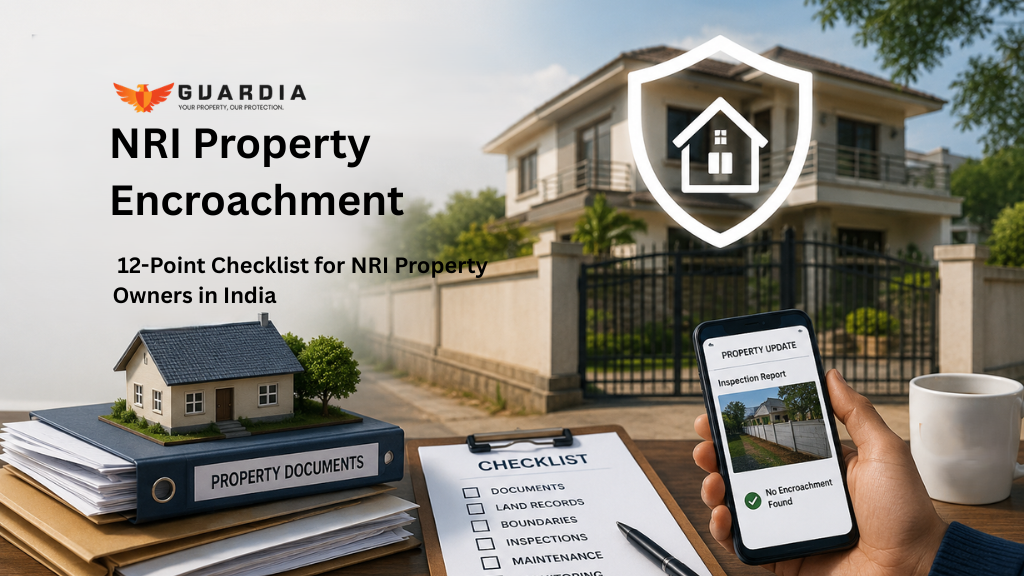
For NRIs, managing property from another country can be challenging. A vacant house, inherited property, agricultural land or plot may remain unattended for months or even years. That distance can make it harder to notice boundary changes, unauthorised construction or someone occupying or using the property without permission.
The good news is that NRI property encroachment is often easier to prevent than to resolve later.
This 12-point checklist explains how NRIs can monitor and protect property in India while living abroad.
What Is Property Encroachment?
Property encroachment occurs when a person uses, occupies or builds on another person’s property without legal permission or authority.
For an NRI, common warning signs can include:
- A neighbour extending a boundary wall or fence
- Unauthorised construction on the property
- Someone using a vacant plot for parking or storage
- Unknown occupants in a vacant house
- A new pathway being created through the land
- Changes to the property’s physical boundaries
An encroachment does not automatically mean that the encroacher acquires ownership. However, prolonged possession can create complicated legal issues. Under Article 65 of the Limitation Act, 1963, a suit for possession of immovable property based on title generally has a 12-year limitation period, calculated from when the defendant’s possession becomes adverse to the plaintiff. The legal requirements for adverse possession depend on the facts of the case.
That is why early detection matters.
12-Point Encroachment Prevention Checklist for NRIs
1. Keep your property documents organised
Maintain accessible copies of your:
- Sale deed
- Title documents
- Mutation records
- Property tax receipts
- Survey records
- Previous agreements
- Relevant registration documents
Keep both physical and secure digital copies.
2. Verify your land records
Periodically check the relevant state land and revenue records to ensure that the owner’s name, survey number, property area and other details remain consistent with your documents.
India’s Digital India Land Records Modernization Programme (DILRMP) is designed to modernise land records, improve transparency, reduce property disputes and make land information more accessible.
However, digital availability does not mean an NRI should stop independently verifying their records.
3. Know your exact property boundaries
For land and vacant plots, make sure you know the property’s:
- Survey number
- Dimensions
- Boundaries
- Access points
- Adjacent properties
If there is uncertainty about the physical boundary, consider obtaining a professional survey or measurement.
Clear boundaries make unauthorised changes easier to detect.
4. Inspect the property regularly
You don’t need to be physically present in India to monitor your property.
Arrange periodic inspections through a trusted local person or professional property manager.
Ask them to check specifically for:
- New construction
- Boundary changes
- Broken fencing
- Unauthorised occupants
- New access routes
- Signs of commercial or residential use
5. Maintain the property
A property that appears completely abandoned may attract unwanted use.
Maintain:
- Gates and locks
- Boundary walls
- Fencing
- Basic structures
- Visible property signage, where appropriate
The purpose is simple: make your ownership and active management visible.
6.Create a photographic record
Ask your local representative to take dated photographs or videos during inspections.
Keep records of:
- All property boundaries
- Main entrance
- Buildings and structures
- Adjacent areas
- Any changes since the previous inspection
For an NRI living abroad, this creates a useful history of the property’s physical condition.
7. Monitor property records and registrations
Depending on the state and property type, periodically check relevant land, registration and encumbrance records.
Government initiatives increasingly integrate land records, cadastral maps and registration information to improve transparency and reduce disputes.
The exact records and online services available will vary by state.
8. Keep the record of taxes and property-related payments
Maintain records of property tax payments and other applicable property-related dues. (e.g., electricity bill or water bill etc. )
These records demonstrate ongoing management of the property, although paying property taxes alone does not establish or protect title against every possible claim.
9. Be careful with Power of Attorney
Many NRIs rely on a family member, friend or professional in India to manage their property.
If you use a Power of Attorney (POA), make sure:
- The person is trustworthy.
- Their authority is clearly defined.
- The document is properly executed.
- You retain a copy.
- You periodically review whether the POA is still necessary.
The Ministry of External Affairs recognises the use of Power of Attorney arrangements for certain transactions involving NRI investments in India, subject to applicable requirements.
Do not give broader authority than necessary.
10. Never ignore a small encroachment
A fence moved by a few feet may not seem urgent.
It can become one. If you discover an unauthorised extension, structure or occupation, document it and seek appropriate legal advice rather than allowing the situation to continue indefinitely.
The Supreme Court’s recent property decisions continue to distinguish between simple trespass/encroachment and the specific legal requirements involved in claims of adverse possession.
11. Act quickly when you see a red flag
If an inspection reveals any unauthorised occupation or construction on the property:
Document → Verify → Seek legal advice → Take appropriate action.
Avoid relying only on verbal assurances from neighbours, cousins or intermediaries.
The appropriate remedy can depend on the property’s location, title, nature of occupation and applicable state laws.
12. Set up a recurring property-monitoring system
For an NRI, property protection should be a process, not a one-time activity.
You can conduct inspections with a time period like:
Monthly: Review property-related updates, bills and communications.
Quarterly: Arrange a physical inspection with photographs or video.
Annually: Review title documents, boundaries, taxes and relevant property records.
Immediately: Investigate any report of an unauthorised occupation, construction or boundary changes.
How Can NRIs Protect Vacant Property in India?
The most effective approach is regular local monitoring combined with proper documentation.
An NRI does not necessarily need to visit India frequently just to check. Instead, they should establish a reliable system which can involve:
- Updated ownership documents
- Clearly identified boundaries
- Periodic physical inspections
- Updated photographs or videos and inspection reports
- Current tax and property records
- Carefully authorised local representation
- Prompt action when irregularities are discovered
This creates visibility even when the owner is thousands of kilometres away.
What Should an NRI Do If Someone Has Already Encroached on Their Property?
If you discover an existing encroachment, don’t assume that waiting will resolve it.
Start by documenting the occupation or construction and gathering your title and property records. Then consult a qualified property lawyer familiar with the relevant state’s laws.
The correct legal remedy depends on the circumstances. In particular, do not assume that the commonly repeated “12-year rule” means an encroacher automatically becomes the owner after 12 years. Article 65 concerns the limitation period for a title-based possession suit, while a claim of adverse possession has additional legal requirements.
Final Takeaway for NRI Property Owners
The biggest risk of owning property from abroad isn’t distance. It’s lack of visibility.
You may not be able to visit your property every few months, but you can still know what is happening there.
Keep your records updated. Know your boundaries. Arrange regular inspections. Monitor relevant records. And most importantly, act when you notice the first warning sign – not years later.
For an NRI property owner, prevention isn’t about constantly worrying about your property.
It’s about having a system that keeps you informed, even when you’re far away.
If you’re an NRI and not sure how to keep your property protected while you’re abroad? Reach out to Guardia – we’re here to help you stay informed and in control.
contact us: +91 720 707 9911, +61 412 603 304
Disclaimer: This article is for general informational purposes only and does not constitute any legal advice. Property, land-record, limitation and encroachment laws and procedures can vary by state and individual circumstances. NRIs facing a suspected encroachment should consult a qualified property lawyer in the relevant jurisdiction.