
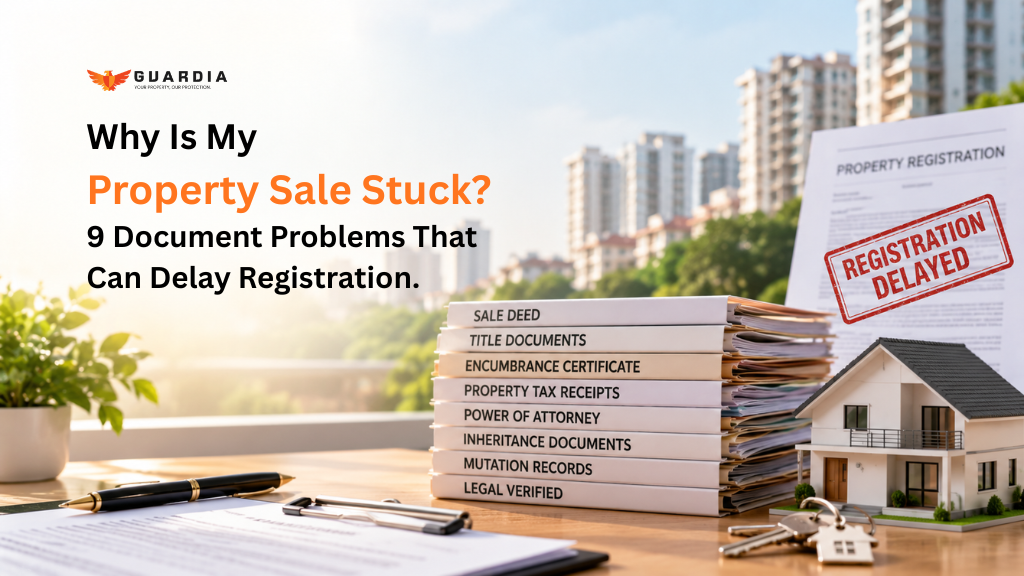
Selling a property in India can look simple until the documentation is actually reviewed. You may have the sale deed, property tax receipts and other papers, yet the buyer’s legal verification can still bring up issues that delay the transaction.
Sometimes the problem is a missing original document. In other cases, the property may still be recorded in a previous owner’s name, an old mortgage may appear in the records, or there may be a gap in the title history. For NRIs, the process can become even more complicated when the owner is abroad and the sale is being handled through a Power of Attorney.
Most of these issues can be identified before the sale reaches the registration stage. The key is to understand what each document establishes and whether the documents together show a clear and consistent ownership history.
Here are nine document-related problems worth checking before putting your property up for sale.
Why can a property sale get stuck even when I have the sale deed?
A sale deed is one of the most important property documents, but it is not necessarily the only document a buyer needs to examine.
A buyer’s lawyer may want to understand how the property reached the current owner and whether there are gaps in the ownership history.
That means having one registered sale deed does not automatically mean the documentation is ready for sale.
Before putting the property on the market, check whether you also have the previous title documents and whether the ownership history is consistent from one transfer to the next.
The real question is not just, “Do I have a sale deed?”
It is: “Can my documents clearly establish how I became the owner?”
1. What if my original sale deed is missing?
This is one of the first problems to solve.
The original title document may be requested during legal due diligence. A photocopy or scanned copy can help establish what the document contained, but it should not simply be assumed to be an acceptable substitute for the original.
If your original deed is missing, first find out:
- Whether the document is with a family member, bank or previous owner
- Whether it was deposited as security for a loan
- Whether a certified copy can be obtained from the relevant registration authority
- Whether previous title documents can help establish the ownership chain
- Whether a property lawyer needs to examine the situation before the sale proceeds
For an NRI, this is worth checking before accepting a buyer’s advance.
A missing document does not automatically mean that the property cannot be sold. But it is much better to understand the available alternatives before a buyer’s legal team raises the issue.
2. What if the property is still in my parent’s or previous owner’s name?
This can become particularly important with inherited property.
For example, your father owned a house, he passed away, and you became the legal heir. But the property records may still show your father’s name.
You may have a genuine claim to the property, but the buyer still needs to understand how ownership passed from the previous owner to you.
Depending on the circumstances, the supporting documents could include:
- Death certificate
- Will, where applicable
- Probate or other court documentation, where applicable
- Legal-heir or succession-related documents
- Release/relinquishment deed, where applicable
- Mutation records
- Previous title documents
The exact requirements depend on how the property was inherited and the succession law applicable to the case.
The important point is simple:
Do not wait until you have a buyer to discover that the title still reflects the previous owner.
3. Can I sell the property if the Encumbrance Certificate shows something?
An Encumbrance Certificate (EC) is commonly checked during property due diligence because it can show registered transactions or encumbrances recorded against the property for the relevant period.
It is therefore not enough to simply obtain an EC and file it away. You need to understand what it actually says.
For example, if a previous loan or mortgage appears in the records, the buyer may ask for evidence that the liability has been cleared.
Before selling, check:
- What period does the EC cover?
- Does it show any mortgage or registered transaction?
- Has an old loan actually been released?
- Do you have the relevant bank release documents?
- Does the information in the EC match your title documents?
An EC is a useful part of the verification process, but it should be read alongside the title documents rather than treated as a standalone “clear title” certificate.
4. What if my property tax receipt is in my name but my title documents are different?
This is another common misunderstanding.
A property tax receipt can show that property tax has been paid in a particular person’s name. But paying property tax does not, by itself, establish a complete and conclusive title to the property.
The buyer’s lawyer will generally look at the ownership documents and the wider title history rather than relying only on tax receipts.
So if you have: Property tax receipt + mutation but your title deed has a different name or there is a gap in the ownership chain, the underlying title issue still needs to be addressed.
This is why it is better to compare your:
- Title deed
- Previous title documents
- Mutation/revenue records
- Property tax records
- EC
before putting the property on the market.
5. What happens if there are multiple owners?
A property may have more than one owner because it was purchased jointly, inherited by multiple heirs, or transferred through a family arrangement.
The problem arises when one person tries to sell the entire property without properly accounting for the interests of the other owners.
Before signing a sale agreement, check:
- Who is named as owner?
- What share does each owner hold?
- Are all co-owners willing to sell?
- Will everyone sign the required documents?
- If one owner is abroad, how will they participate?
- Is a valid Power of Attorney required?
A disagreement between co-owners can turn a straightforward sale into a much longer process.
It is better to identify the ownership structure before negotiating with a buyer rather than after the buyer’s lawyer starts reviewing the documents.
6. Can an NRI sell the property if they are not coming to India?
Being abroad does not automatically mean an NRI has to fly to India for every property sale.
Under RBI’s Foreign Exchange Management (Acquisition and Transfer of Immovable Property in India) Regulations, 2018, NRIs and OCIs can transfer eligible immovable property in India, subject to the applicable conditions. Agricultural land, farmhouse and plantation property are subject to separate rules.
Reserve Bank of India — FEMA Regulations on Acquisition and Transfer of Immovable Property
If the owner cannot attend personally, a Power of Attorney may be used to authorise another person to act on their behalf.
But the important question is not simply: “Do I have a Power of Attorney?”
It is: “Does my Power of Attorney actually give the attorney the authority needed for this sale?”
The document should be properly drafted and executed for the intended transaction, with the applicable stamping, authentication and registration requirements followed.
A generic PoA created years ago for “property management” may not necessarily be suitable for executing a property sale.
If you are selling from overseas, have the PoA reviewed before relying on it for the transaction.
7. What if the property documents and owner’s name don’t match?
Small differences in names can become surprisingly important during a property transaction.
For example:
- Sale deed: S. Ramesh
- PAN: Ramesh Kumar
- Passport: Ramesh Subramanian
- Property records: Ramesh S.
Sometimes the difference is explainable. Sometimes it requires supporting documentation.
Similarly, a change of name after marriage or another legal name change may need to be supported by appropriate records.
Before selling, compare the name and other identifying details across:
- Title documents
- PAN
- Passport
- Property records
- Bank records
- Power of Attorney, if applicable
If there is a mismatch, get it reviewed early rather than waiting until registration day.
A small correction may be easy to handle. A mismatch involving the ownership records can be much more complicated.
8. What if the apartment’s approvals or property records are incomplete?
For apartments and constructed properties, title is only one part of the documentation.
Depending on the property and local requirements, the buyer may also ask about documents relating to the construction and occupation of the property.
These can include:
- Approved building plan
- Occupancy Certificate
- Completion Certificate, where applicable
- Relevant municipal records
- Society or builder documents
- Applicable NOCs
- Property tax records
Not every property will have exactly the same documents, and requirements can vary by property type and local authority.
The important thing is to identify missing approvals before the buyer’s lawyer raises them.
If you bought an apartment many years ago, it is worth checking whether you still have the relevant builder, society and approval documents before starting the sale process.
9. Can an NRI sell first and figure out the tax and repatriation documents later?
This is where an apparently successful sale can create a second problem.
The sale itself and the transfer of the money outside India are separate compliance steps.
For NRI sellers, the tax treatment and applicable TDS obligations need to be considered as part of the transaction.
There has also been an important change in India’s tax framework in 2026.
For remittances made on or after 1 April 2026, the Income Tax Department’s new framework uses Form 145 and Form 146. Form 145 corresponds to the earlier Form 15CA, while Form 146 corresponds to the earlier Form 15CB in the applicable cases.
Income Tax Department — Form 145
Income Tax Department — Income Tax Forms
So, if you are an NRI seller, do not rely on an old property article that simply tells you to follow the previous Form 15CA/15CB process without checking whether the transaction falls under the current framework.
And what about sending the money abroad?
RBI rules also matter.
For eligible property sales, repatriation of sale proceeds is subject to FEMA conditions. Under the 2018 FEMA regulations, repatriation of eligible property sale proceeds depends, among other things, on how the property was acquired and how the purchase consideration was funded. For residential property acquired through permitted foreign-exchange routes, the regulations also specify a two-property limit for repatriation.
Reserve Bank of India — FEMA Regulations on Acquisition and Transfer of Immovable Property
For other assets and NRO balances, RBI’s guidance provides a USD 1 million per financial year remittance facility for eligible NRIs/PIOs, subject to the applicable conditions. RBI’s more recent account guidance continues to reference this limit under the Foreign Exchange Management (Remittance of Assets) Regulations, 2016.
RBI — NRI/PIO Repatriation Guidance
The exact route can depend on whether the property was purchased using foreign exchange, rupee funds, inherited, or acquired under another permitted route.
So the question should not only be: “Can I sell my property?”
It should also be: “What will I need to document the source, tax compliance and eligible repatriation of the sale proceeds?”
What should I check before putting my property up for sale?
You do not need to wait for a buyer’s lawyer to start checking your documents.
Do a basic pre-sale document audit first.
Ownership
- Do I have the current title deed?
- Do I have the previous title documents?
- Is the property in my name?
- Are there any co-owners?
- If inherited, is the succession documentation complete?
Property records
- Is the EC available?
- Are there any registered encumbrances?
- Are property taxes up to date?
- Do mutation/revenue records match the ownership?
- Are relevant building approvals available?
Sale authority
- Can I personally attend the transaction?
- If not, is the Power of Attorney properly drafted?
- Does the PoA give the required authority?
- If there are co-owners, has everyone been accounted for?
Tax and money
- Do I have records of the original purchase cost?
- Do I have records of eligible improvement expenses?
- Has the capital-gains position been reviewed?
- Has the applicable TDS process been checked?
- If I am an NRI, have I checked the FEMA and repatriation requirements?
What should I do if one document is missing?
Do not immediately assume that the property cannot be sold.
First determine what the missing document proves and why the buyer needs it.
A missing property-tax receipt may be relatively straightforward to address.
A missing original title deed can require a much more careful solution.
An unresolved inheritance issue can affect the ownership itself.
And an incorrectly drafted Power of Attorney can affect whether someone has the authority to complete the transaction on your behalf.
These are very different problems, so they should not all be treated as “missing paperwork.”
The right solution depends on what the missing document is, what the existing records show, and whether another document can legally establish the same fact.
The safest time to find a document problem is before you find a buyer
Most sellers think document verification starts after a buyer makes an offer.
It is usually better to do the opposite.
Check the title before marketing the property.
Check the ownership before negotiating the price.
Check the tax position before agreeing to the payment structure.
And if you are an NRI, check the Power of Attorney and repatriation requirements before assuming that someone in India can simply complete the sale for you.
A property sale can move quickly when the paperwork is clean. But if a title gap, missing document or ownership issue appears after the buyer has already committed, the transaction can become stressful for everyone involved.
Final takeaway
The most important property-sale document is not necessarily the document with the most impressive name.
What matters is whether the complete set of documents tells a consistent story:
Who owns the property → how they acquired it → whether anyone else has a claim → whether the property has registered encumbrances → whether the seller has authority to sell → and whether the transaction can be completed and the proceeds handled compliantly.
That is what a buyer’s lawyer is ultimately trying to establish.
So before asking:
“What documents are required to sell my property?”
ask the more useful question:
“Can my documents clearly prove that I have the right to sell it?”
If you’re an NRI selling property in Telangana, our detailed guide on Documents Required to Sell NRI Property in Telangana covers the documents and practical requirements specific to that process.
For NRIs managing property from overseas, Guardia can also be useful when the challenge is not just understanding the paperwork, but coordinating the practical work in India. It provides a platform for managing property-related tasks and getting on-ground support while the owner remains abroad.
The goal is simple: identify documentation problems before they become sale problems.
This article is for general informational purposes and should not be treated as legal, tax or financial advice. Property-sale requirements can vary depending on the property, ownership history, location and transaction structure. NRIs should obtain transaction-specific advice from a qualified property lawyer, CA or authorised dealer bank where required.



Pingback: Fix NRI Property Sale Document Problems | Guardia